In 1960, the physicist Eugene Wigner published a short essay with a title that has never stopped being provocative: The Unreasonable Effectiveness of Mathematics in the Natural Sciences. His observation was simple and devastating: mathematics, developed by pure reason with no regard for the physical world, describes that world with startling and inexplicable precision. This is not obvious. It is not even, when you think about it carefully, expected.
Consider Euler's identity, often called the most beautiful equation in mathematics:
Here five fundamental constants — $e$, $i$, $\pi$, $1$, and $0$ — combine in a single, crystalline relation. No physicist asked for this. It emerged from the internal logic of complex analysis, yet it is indispensable in quantum mechanics, electrical engineering, and the theory of waves.
The Case of Fourier
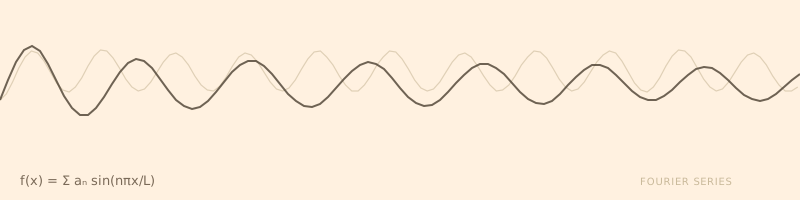
Joseph Fourier was studying heat. His question was narrow and practical: how does temperature distribute itself through a metal rod over time? The answer he found was a series:
where the coefficients $a_n$ and $b_n$ are computed by integrating $f$ against each harmonic:
The Fourier series is now the backbone of signal processing, image compression (JPEG), quantum mechanics, optics, acoustics, and the analysis of financial time series. Fourier had no idea. He was thinking about heat.
Maxwell's Equations and the Speed of Light
Perhaps the most dramatic instance of Wigner's observation is Maxwell's equations. Written in their compact modern form using the divergence and curl operators:
Maxwell noticed something in his own equations. Combining them yields a wave equation with propagation speed:
He computed this number from purely electrical measurements made in a laboratory. It came out to $\approx 3 \times 10^8 \, \text{m/s}$ — exactly the speed of light. Maxwell had not been studying light. He had been studying electricity and magnetism. The mathematics told him, without being asked, that light is an electromagnetic wave.
"We can scarcely avoid the conclusion that light consists in the transverse undulations of the same medium which is the cause of electric and magnetic phenomena." — James Clerk Maxwell, 1865
A Few Tentative Answers
Why does this happen? Three kinds of answer are usually offered, none fully satisfying.
The first is selective attention: we only notice mathematics that works. For every abstract structure that describes reality, there are infinitely many that describe nothing at all. We simply do not write papers about the failures.
The second is evolutionary: human cognition evolved in a world governed by physics, so our mathematical intuitions are shaped by the same laws they later rediscover. On this view, the effectiveness of mathematics is a kind of cognitive homecoming.
The third — and the one I find most interesting, though also the most vertiginous — is structural realism: the world is mathematical structure, not merely described by it. There is no deeper physical substrate beneath the equations; the equations are the thing itself. If this is right, Wigner's puzzle dissolves, but only by becoming something stranger.
I do not know which answer is correct. I am not sure the question has a correct answer in the usual sense. What I am sure of is this: the next time you integrate a Gaussian,
pause for a moment. That $\pi$ has no obvious business being there. It belongs to circles. Yet here it is, inside an exponential, inside an integral over the whole real line — because the universe, apparently, insists on it.